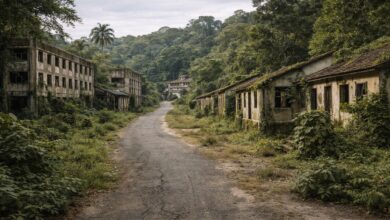
On the western shore of Narragansett Bay, overlooking open water and shipping lanes, Fort Adams stands as one of the largest and most complex coastal fortifications ever built in the United States. Constructed in the nineteenth century and expanded over decades, the fort was designed to control movement, regulate access, and withstand prolonged threat. Its haunted reputation did not arise from legend alone, but from architecture, isolation, and the accumulated weight of long military use.
What remains today is not an abandoned ruin, but a preserved military environment where function outlasted comfort. Fort Adams does not feel empty. It feels held.
Presence here was engineered.
A fortress built for endurance
Fort Adams was designed as a defensive system rather than a single structure. Thick stone walls, underground corridors, and layered bastions formed a network meant to absorb pressure and restrict movement. Every element prioritized defense over ease.
The fort’s scale reflected long term intention. It was not built for brief conflict. It was built to remain operational across generations. Similar human responses to silence and environment appear in old Melbourne Gaol.
Endurance shaped design.
Controlled movement and interior tension
Inside Fort Adams, circulation was carefully regulated. Narrow passages, low ceilings, and limited light guided bodies through space with precision. Rooms served specific functions and offered little flexibility.
This architecture produces a persistent sense of compression. Even without activity, interiors feel occupied by purpose. Movement is directed. Pause feels discouraged.
Control remains perceptible.
Long service without dramatic closure
Unlike forts abandoned after a single conflict, Fort Adams remained active through multiple eras. It adapted to new military needs, housed personnel, and maintained readiness even as technology changed.
Because service ended gradually rather than abruptly, the fort did not experience a single moment of closure. Activity diminished over time, leaving spaces intact but unused.
Function faded. Structure remained.
Isolation along the waterline
Despite its proximity to Newport, Fort Adams occupies a position of separation. Surrounded by water on multiple sides, access routes are defined and limited. The fort was meant to observe rather than participate in surrounding life.
This separation intensified the internal environment. Daily routines unfolded within walls designed to block rather than welcome.
Distance reinforced focus.
Haunted reputation as spatial response
Fort Adams is frequently described as haunted, yet this reputation aligns closely with its physical conditions. Long corridors amplify sound. Stone surfaces hold temperature and echo movement. Enclosed rooms preserve stillness.
These qualities create heightened awareness rather than narrative fear. The sensation many visitors report emerges from architecture and memory rather than unexplained events.
Design shapes perception.
Absence managed, not accidental
As a preserved historic site, Fort Adams remains maintained and monitored. Decay is limited. Access is guided. The fort is neither abandoned nor fully active.
This condition creates an unusual atmosphere. Spaces are empty by policy, not neglect. Silence is regulated.
Stillness is intentional.
Why Fort Adams still resonates
Fort Adams matters because it demonstrates how environments built for control continue to exert psychological influence long after their original purpose ends. It shows how authority, repetition, and enclosure leave durable impressions.
The fort does not require embellishment to feel intense. Its structure provides sufficient explanation.
Evidence remains visible.
Memory embedded in stone
Every corridor and chamber at Fort Adams reflects repetition. Footsteps once followed strict schedules. Watches were kept. Orders were enforced. Those routines shaped how space was used and perceived.
When activity ceased, the imprint did not disappear. The fort remembers through layout and proportion.
Memory persists through form.
Haunted reputation as spatial response
Fort Adams is frequently described as haunted, yet this reputation aligns closely with its physical conditions. Long corridors amplify sound. Stone surfaces hold temperature and echo movement. Enclosed rooms preserve stillness.
These qualities create heightened awareness rather than narrative fear. The sensation many visitors report emerges from architecture and memory rather than unexplained events.
Design shapes perception.
This perception has also shaped how Fort Adams appears in public media. The site is featured in an episode of Kindred Spirits, included as part of the series’ broader focus on locations marked by long use, memory, and unresolved spatial tension. These references are provided solely as indicators of public media interest. All observations in this article are grounded exclusively in the fort’s remaining physical structure, documented history, and observable environmental conditions.
YouTube playlist: Kindred Spirits – Travel Channel
IMDb episode listing: Buried Alone – Rhode Island
Enduring Perspective
Fort Adams endures as a coastal fortress where architecture, long service, and controlled isolation shaped a haunted reputation grounded in physical reality. Its power lies not in mystery, but in continuity. Walls remain thick. Corridors remain narrow. Silence remains structured. In Newport, Fort Adams demonstrates how places built for vigilance retain that posture long after vigilance is no longer required. Related reflections on memory and perception can also be found in Tak Tak Schoolhouse.
Horizon Report documents places shaped by memory, infrastructure, and human decision making. Our work focuses on what remains physically visible, how abandonment unfolds, and how interpretation is clearly separated from observable evidence.
For additional context, the following background articles explore patterns of abandonment, loss of use, and preservation.
- Abandonment And Ghost Towns
- What Is A Ghost Town
- Why Towns Are Abandoned
- Preserving Abandoned Places
Editorial transparency matters. Observations are grounded in site layout, materials, remaining structures, and documented timelines. Interpretation is presented as interpretation, not assertion.
Attentive readers often spot refinements worth making. Thoughtful feedback supports accuracy, clarity, and long term editorial integrity.